This list comes from trips across seven time zones with two children who sleep perfectly at home and badly in the air, plus every schedule I have written for families heading east. Jet lag in children is shorter than in adults and considerably louder, and it usually arrives as an argument at an hour when nobody is at their best. The order below is what I do in the first seventy-two hours after landing.
Shift the bedtime three days out
Moving the whole routine half an hour earlier on each of the three days before departure is the cheapest fix available, and it costs nothing except a calendar entry. It buys back about ninety minutes of the gap before anyone gets on a plane, and a family that lands with ninety minutes in hand has a much better first night than one that lands owing three hours.
- Three days out: bedtime thirty minutes earlier, naps included.
- Two days out: another thirty minutes, and screens off at the new time.
- Day one on arrival: the local schedule starts whether or not anyone slept.
The shift works because nobody has to be perfect about it, and a missed evening costs far less than starting the whole thing on the aircraft. Families who begin negotiating in the air end up discussing bedtime with a child who has just been handed a window seat and has no intention of closing it.
Work in the direction of the travel
Eastwards, everything moves earlier: wake-ups, naps, dinner, all of it, and the day should feel like it started before anyone wanted it to. Westwards the day stretches instead, and I let the children stay up rather than dragging them to a bed their bodies still call the wrong hour. Getting this backwards costs a night, and getting it right costs only an hour of evening patience.
Eastwards I move lunch earlier as well, because a body eating at the wrong hour keeps insisting the hour is wrong. Westwards the danger flips: a child put to bed at nine reads the local morning as bedtime and wakes the whole floor at three.
Get outside in daylight on day one
Light is the strongest signal the body has, and a morning outdoors does more than any routine I have ever written down. I aim for an hour outside before midday, usually as three short walks rather than one long one, because a child will not sit in a park for the whole hour. If the weather is poor I take the brightest part of the day and stand under it anyway.
On the days that follow I repeat the same morning walk at the same hour, even when it is short and grey. The routine does more than the weather does, and a predictable hour beats a bright one that nobody manages to find.
Cap the first nap at two hours
A long daytime sleep on day one feels kind and pushes the night back by precisely the amount you cannot afford. I set one alarm for the nap and I wake them, then keep the afternoon to light play and a walk of about twenty minutes back to the room. This is the rule families break most often, and it is the one that decides whether the second night improves or repeats the first.
If the nap collapses completely I still hold the wake-up time, because the following night depends on it more than on how long anybody slept that afternoon. A short doze in the pram is harmless, and a two-hour one at four in the afternoon is not.
Eat on the new clock
Meals tell the body what time it is more reliably than any clock on the wall, so breakfast, lunch and dinner land on the local schedule from the first day. If we land in the morning, breakfast happens whether anyone is hungry or not, and I keep the portions small rather than skipping it. Sugar and caffeine do the same damage at the wrong hour as a nap does, so both move with the meals.
Water sits beside the meals as well, and I keep a bottle in the room for the three in the morning when a child wakes convinced that it is breakfast time. Nothing heavy after the flight either, since a full stomach at the wrong hour delays the sleep instead of helping it.
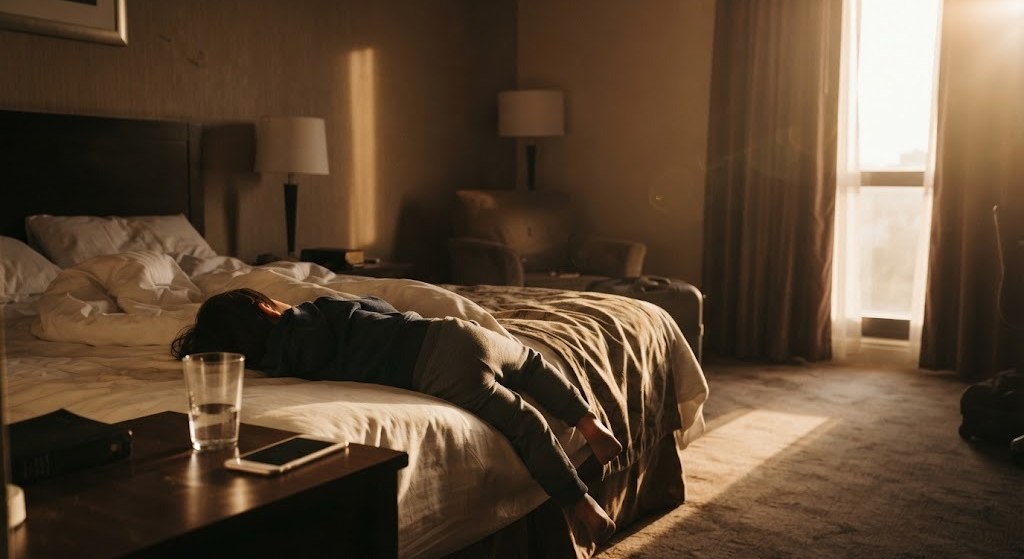
Make the first room easy to sleep in
Blackout curtains, a room under twenty-one degrees and one adult who stays awake for the first hour cover most of the first night, and I ask the hotel for those before arrival rather than at midnight. A room that faces the sunrise is a room that wakes a child at five for three mornings running, so I request the courtyard side when I book. If two things survive a hard week, make them the three-day shift and the two-hour nap cap, because the nights line up on their own once those two hold.